Pin Drop
Pin Drop is a mapping and location platform used by millions of people across 180+ countries. I designed and launched it in 2011 as a side project inside my agency. It reached the top of the App Store, outlived the company that built it and came back a decade later as an independent business.
- Role
- Founder, designer and product lead
- Year
- 2011 to present
- Work
- Web design, App design, Marketing, Branding, Growth, Product, Partnerships, Advertising
- Live
- pindrop.it
Pin Drop is a mapping and location platform used by millions of people across more than 180 countries. Companies use it to plan routes, brief teams and manage the places their work depends on. Red Bull F1 ran a road race across California and Nevada on it. Lupine Races tracked participants across Europe.
It is also one of the oldest mapping apps still running.
It has been through three distinct lives to get here and the middle one nearly ended it.
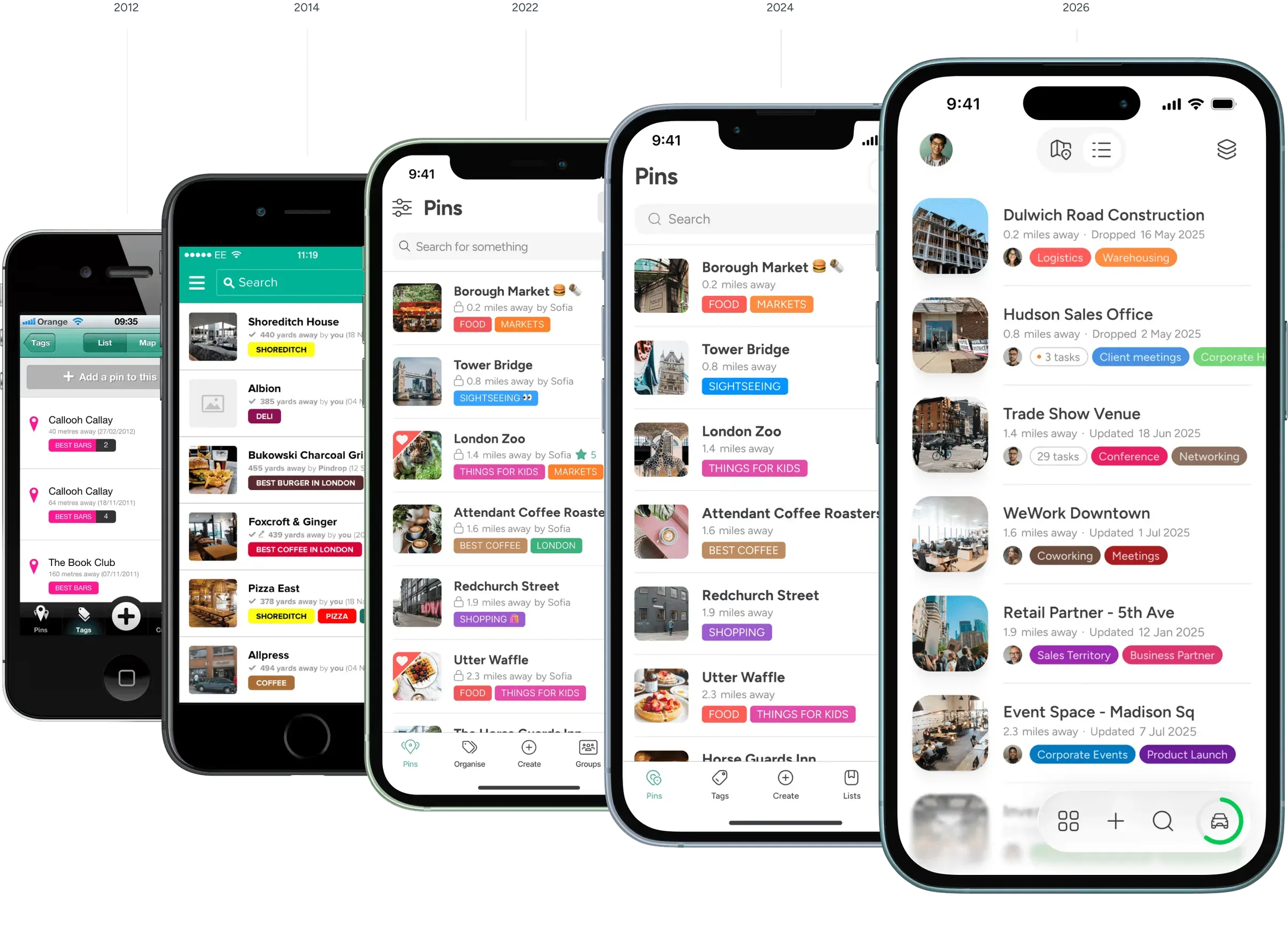
The problem, 2011
I was three people in a railway arch behind Cargo in Shoreditch, running a design studio called Caffeinehit. The App Store was new. There was almost no documentation for designing on it. Photoshop was the only tool any of us had.
I bought an iPhone to learn the platform and found the “Drop a Pin” feature in Apple Maps, then powered by Google. For someone with an appalling memory for places it felt revolutionary, until I went back a few days later and found my pin gone. You could only hold one at a time. Naming a new one overwrote the last. No notes, no detail, no way to keep any of it private.
Foursquare and Gowalla had the social half of this solved. Nobody had built the private half: a place you save for yourself, with your own reasons attached.
That gap was the product. Pin Drop launched in April 2011.
Free was the decision that mattered
I priced it at £1.99, which was steep for 2011. The app was there to show what the studio could do and to stop me forgetting places, so volume was not the point.
A few months in I dropped the price to zero. That single decision changed the trajectory. Within hours it was climbing the App Store charts, not only in Travel and Navigation but across the whole store, with Italy, Germany and the UK taking to it hardest.
The lesson held: for a utility people reach for weekly, the price was not filtering for quality of user, it was filtering out almost all of them.
Over the next two years Pin Drop was named one of Apple’s Best Apps of 2013 and picked up recognition from The Webby Awards, The Europas, The Lovie Awards, W3, The Sunday Times, Time Out, Wired and Lonely Planet. It was featured across 182 App Stores. It also became the studio’s best piece of business development, bringing in inbound work from Mr & Mrs Smith, KFH, Top10 and WIWT.
One of those projects was Summly. Building it introduced me to Stephen Fry, who offered to connect me to Jony Ive and Eddie Cue before my first trip to California in 2013. Ive made time during iOS 7 launch week. I spent an hour one to one taking him through what we had built and where Pin Drop was going. He was generous with his attention and unambiguous about my demo technique: never present flat PNGs to someone who designs in physical materials.
The relaunch that broke
We rebuilt Pin Drop from the ground up and relaunched in November 2013 with a global Apple feature behind it.
It crashed on launch day. The cause was a bug in Facebook’s SDK, which sat in the login path and therefore in front of the entire app. One-star reviews arrived faster than we could respond. Apple pulled the UK feature to stop the bleeding. Facebook confirmed the bug to us in person at their London office weeks later. They never acknowledged it publicly.
The technical lesson was expensive and I have applied it ever since. Never put a third party in the critical path of a first run experience. Never ship a rebuild and a new dependency on the same day as a feature you cannot reschedule.
Going all in and the exit that followed
The recognition was enough to convince me to bet properly. In 2014 I shut down the agency side of the business to focus entirely on Pin Drop, raised funding and hired a team.
Six months later the promised follow-on round fell through and the runway ran out. I had enough to pay everyone to the end of the month, so I gave the team a choice: leave immediately and start looking, or stay two weeks and make Pin Drop work offline so the app could survive without us. All but two stayed.
Then I sent one email to Apple, Google and Facebook with a subject line of “hire us or buy us”. Apple flew executives in from China and California to meet us in London. By the end of that day the entire team had jobs. I spent the next two years on the core Apple Maps design team.
The company did not survive. Every person in it landed. The product outlived the business.
Ten years dormant, then deliberate
While Caffeinehit was being liquidated I suggested to a friend that he talk to the liquidators about Pin Drop’s assets. He bought the lot, then told me that whenever I wanted it back, it was mine.
It sat in the App Store for the better part of seven years, untouched. I came close to restarting in early 2020, three months before COVID and a second child made that a bad idea. In March 2021, almost ten years to the day since the first launch, a former colleague and I ran a kick-off call and started again.
The code was one OS release away from breaking entirely. Six months of repair work later we relaunched. As far as we can tell not a single user lost their data in the transition. For the following year it was two people working evenings around full-time jobs.
Where it is now
Pin Drop is an independent, funded company again. The monetisation route we identified in 2014 turned out to be the right one: nobody had built it in the intervening decade.
It is built by a small team working across London, Lisbon, Manchester and Yerevan, which is three more countries than the railway arch managed.
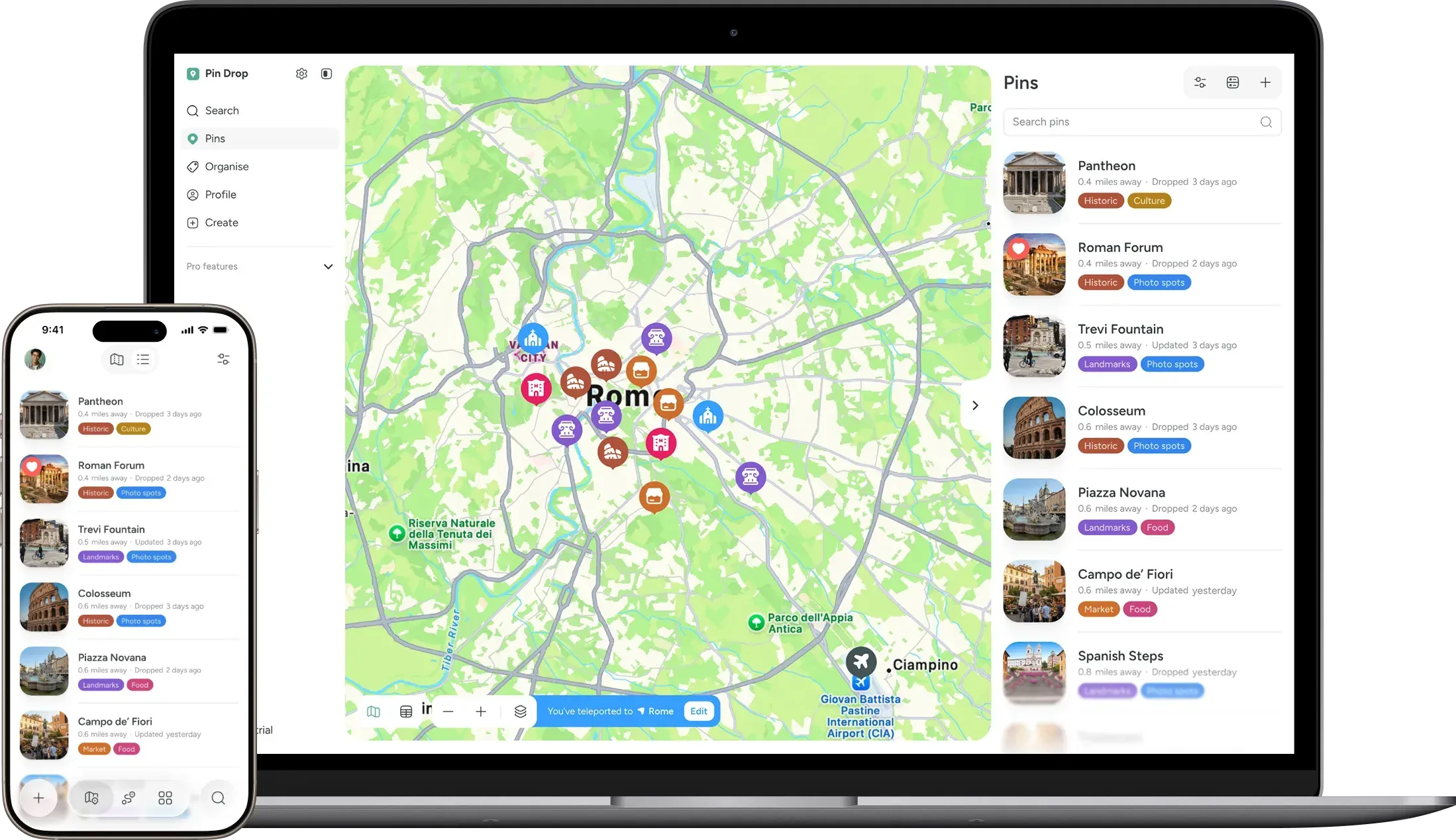
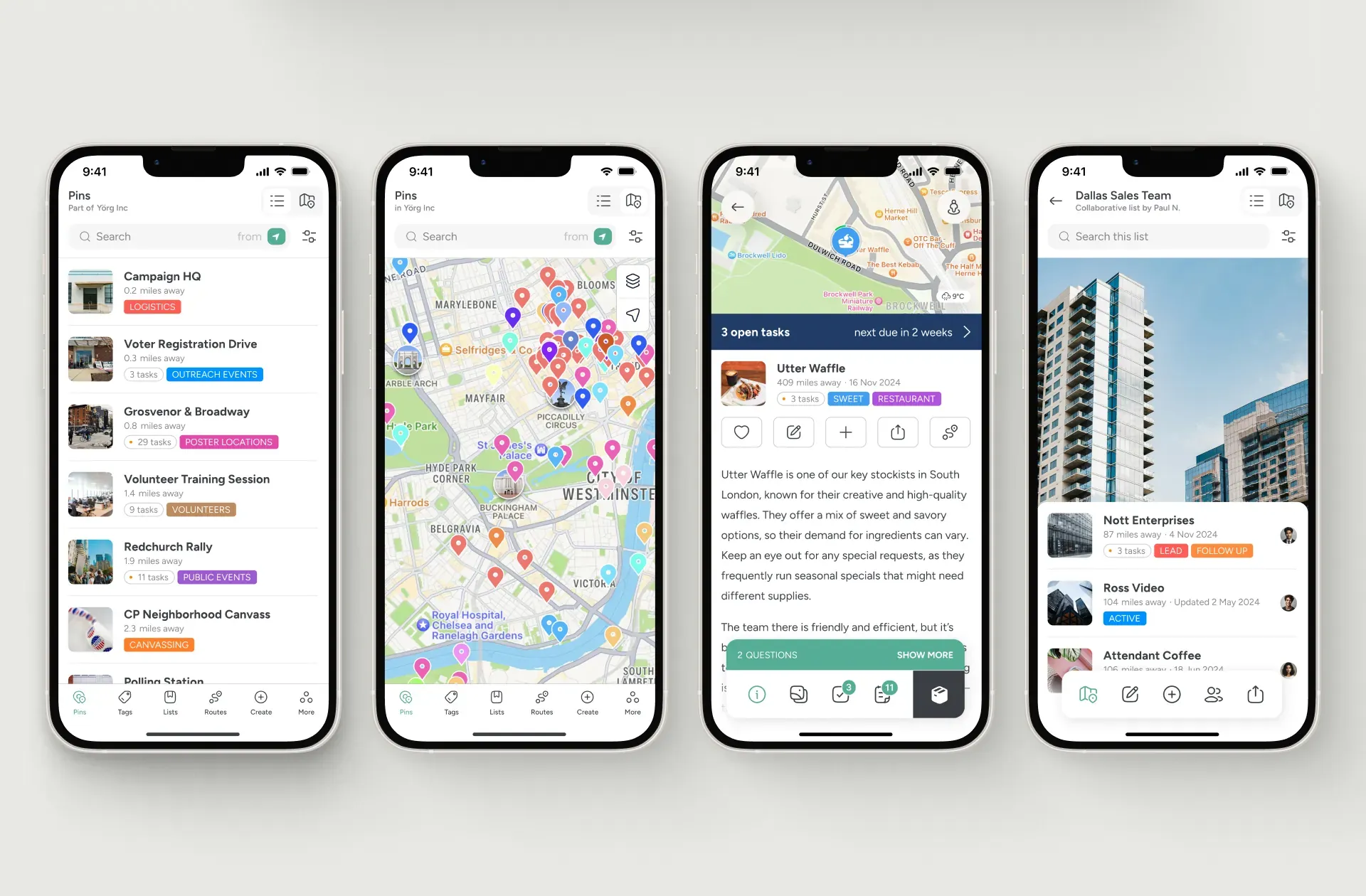
The product now runs in two directions at once. Consumers still use it for the thing it was invented for, keeping private, annotated records of places that matter. Businesses use it as shared infrastructure, collaborating on locations across teams, which is where the revenue is.
The business version treats a place as a record rather than a marker. A pin carries photographs, an owner, a task list, a next event and whatever site detail the job needs, so the map becomes the thing a team works from rather than a picture of where the work is.
Fourteen years from a side project in a railway arch, the original insight has not needed changing. Only the scale has.

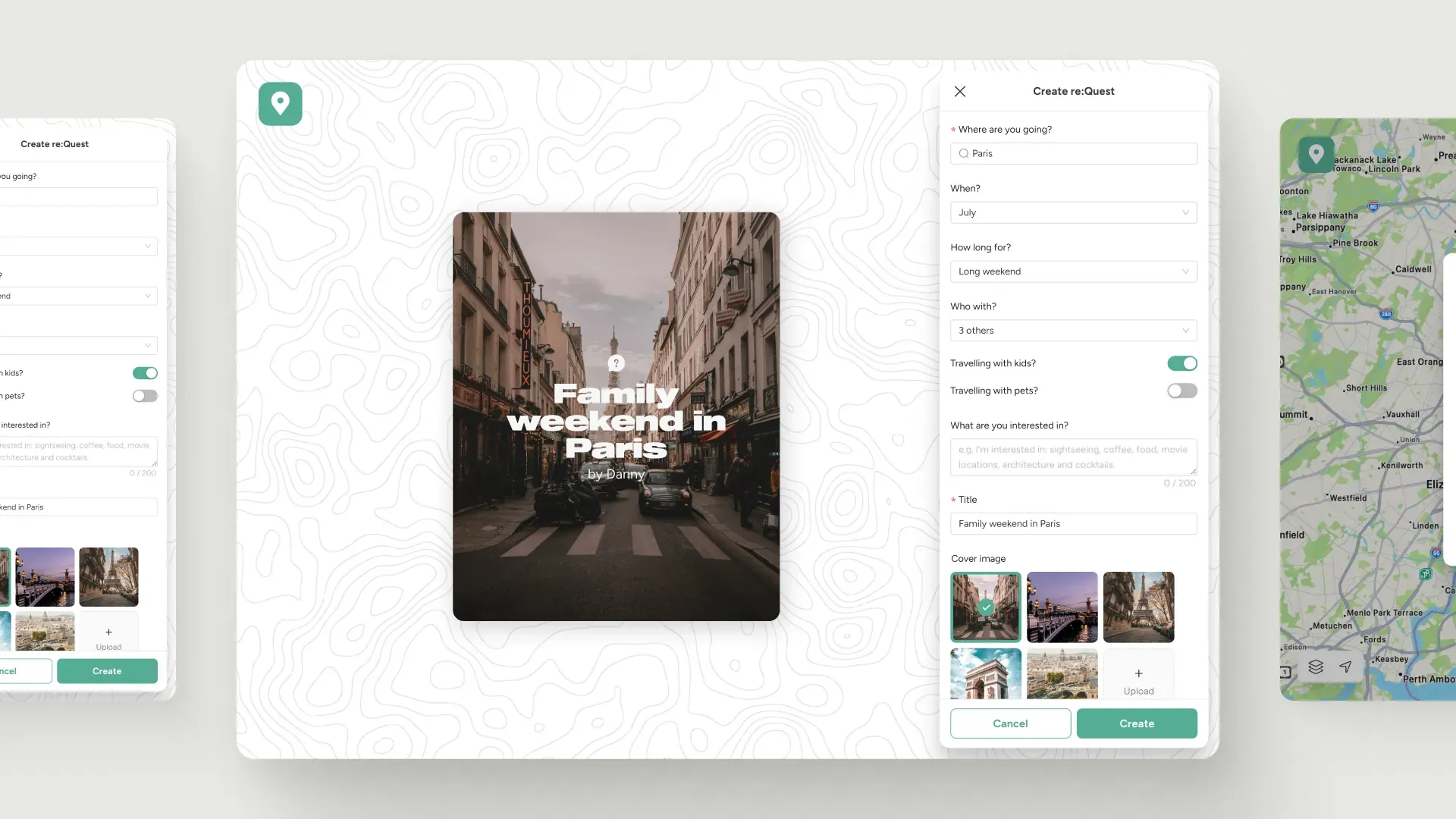
The plan becomes the record. Everything saved before a trip turns into where you actually went, kept by the map rather than written up afterwards. The same mechanic is what makes it work for a crew: the places you planned around become the log of what happened at each one.